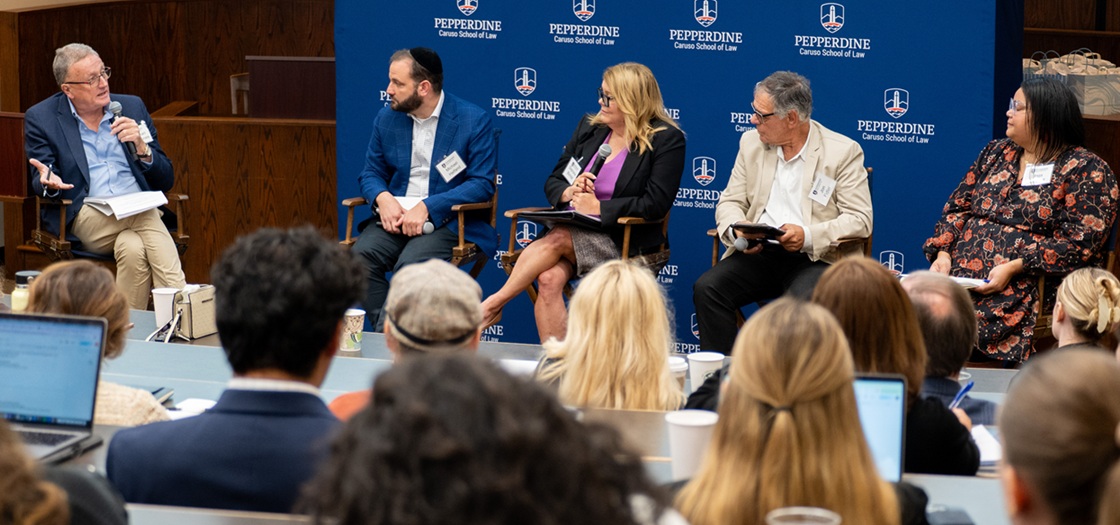
Dispute Resolution Law Journal Symposium Explores Mediator Identity, Technology, and the Future of Mediation
On November 7, 2025, the Straus Institute for Dispute Resolution, the Graduate Law Programs, and the Dispute Resolution Law Journal hosted the annual Dispute Resolution Law Journal Symposium, titled “Mediator 2.0: Shaping Identity in a Changing ADR Landscape.” Led by faculty advisor Dr. Helen Winter and symposium editor Gabrielle Poremba, the event brought together leading scholars and practitioners from around the world to explore how mediators are redefining their professional identities amid evolving questions of faith, technology, and ethics.
Held at Pepperdine Caruso School of Law, the symposium drew a large audience of students, faculty, alumni, and professionals. The day featured a keynote address from Rachel Viscomi, clinical professor at Harvard Law School and director of the Harvard Mediation Program, whose insights on mediator adaptability and human connection in the digital era set the tone for a day of deep reflection and dialogue.
The first panel, “Bridging Belief and Neutrality: Mediator Identity in Faith-Based Communities,” was moderated by Jonathan Lloyd-Jones, president of the International Academy of Mediators. Panelists professor Michael Helfand, professor Stephanie Blondell, Inga Laurent, and Jon Fidler explored how mediators navigate religious identity and neutrality when engaging with faith communities worldwide.
The second panel, “The Future Mediator: Navigating Identity Amid AI and Online Dispute Resolution,” moderated by Steve Paul, brought together experts Clare Fowler, Jacob Ward, and Anja von Rosenstiel to discuss the expanding interface between technology and human judgment. From algorithmic ethics to virtual mediation environments, the session spotlighted how technology is transforming the profession.
In the closing discussion, “Ethics, Identity, and the Neutral Role: The Mediator as Convener for Needed Dialogue,” moderator Winter guided panelists David Hoffman, Colleen Passard, Barbara Cornish, and Elahe Amani through a powerful conversation about how mediators can step up as convenors for dialogue and lead across polarized divides and foster trust through ethical presence and inclusion.
Throughout the day, attendees engaged in meaningful exchanges reflecting Pepperdine’s mission of purpose, service, and leadership. The symposium highlighted not only Straus’s continued leadership in dispute resolution education but also its global reach, featuring thought leaders from Harvard University, the United Kingdom, and Canada, and reaffirming the collegial academic exchange that defines the alternative dispute resolution community.