Pepperdine Caruso Law Hosts United States Supreme Court Justice Ketanji Brown Jackson for 2026 Vincent S. Dalsimer Moot Court Competition and Dean’s Speaker Series
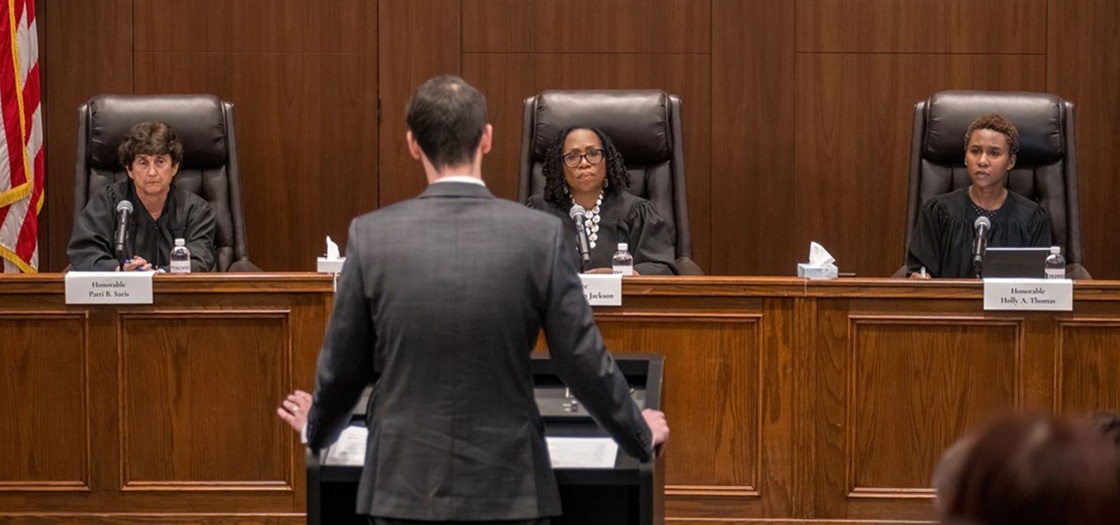
Pepperdine Caruso School of Law was pleased to welcome United States Supreme Court Justice Ketanji Brown Jackson, who presided over the Final Round of the Vincent S. Dalsimer Moot Court Competition held on January 30, 2026, alongside the Honorable Holly A. Thomas, Circuit Judge for the United States Court of Appeals for the Ninth Circuit, and the Honorable Patti B. Saris, District Judge for the United States District Court for the District of Massachusetts, for whom Justice Jackson served as a law clerk from 1996 to 1997.
Student finalists Megan Hoefs and Isaac Zwerling argued for the petitioner, while Natasha Spear and Dillon Johnson represented the respondent, with Hoefs and Zwerling ultimately being declared the winning team.
“Both sides were excellent," said Justice Jackson, emphasizing the difficulty of choosing a winner between two exemplary Pepperdine Caruso Law teams. "They showcased thoughtful presentations and demonstrated impressive skills with respect to focusing on particular cases, memorizing the legal standards, and having a great command of the record.”
For Hoefs and Zwerling, the opportunity to speak in front of an esteemed panel of legal professionals, including Justice Jackson, was not only a significant milestone, but also a reaffirmation of why the pursuit and safeguarding of justice is a deeply meaningful purpose.
"Arguing in front of Justice Jackson, as well as a powerhouse all-female panel, meant the world to me as a woman entering this profession,” shared Hoefs. “This experience reminded me of the importance of remaining tenacious and authentic to myself and my values in pursuit of my own goals, and the paramount ideal of justice for all, especially in the face of adversity."
Zwerling added, "This experience made clear how the strongest advocate serves as a resource to the court. Such advocacy takes the form of listening and answering questions, focusing more on helping the court than making a rehearsed argument.”
The Vincent S. Dalsimer Moot Court Competition is named for the Honorable Vincent S. Dalsimer, former dean and associate dean of the Caruso School of Law, and is one of several in-house competitions held throughout the year. The competitions are organized by the Moot Court Board, a student-run organization that invites upper-division students to showcase their advocacy skills in spirited competition, while attracting distinguished jurists to serve as final-round judges.
Following the competition, Paul Caron, the Duane and Kelly Roberts Dean of the law school, hosted a moderated conversation with Justice Jackson as part of the Dean’s Speaker Series. This high-profile event welcomes distinguished scholars, judges, government officials, and other leaders with diverse perspectives to share views on important issues in law and policy with the law school community—enriching intellectual life and inspiring meaningful dialogue in an atmosphere of mutual respect.
"The Dean’s Speaker Series is an important expression of Pepperdine Caruso Law’s commitment to academic excellence and Christian faith," explained Arnold Barba, chief of staff and associate dean of professional development, as he opened the event. “Our fusion of these two pillars elevates the aim of our fearless pursuit of truth and discourse through respectful dialogue in a community of belonging for the betterment of each other, our nation, and our world. By hearing from diverse backgrounds, experiences, and perspectives, we embrace our calling to uncompromised academic rigor and Christian values.”
As part of her introduction, Justice Jackson addressed the audience with a reading from her memoir, Lovely One, centering on the historic day she was sworn into the Supreme Court on June 30, 2022. She reflected on the nerves, symbolism, and deep personal meaning of the ceremony, recounting how she took the oath on two Bibles: her family’s cherished Justice Jackson Bible and the historic Harlan Bible, which has been used by Supreme Court justices since 1906. As the first Black woman appointed to the Court, she spoke about the journey that led her to that moment, the prayers and support she received from across the nation, and her desire to share her unique story through her memoir.
Reflecting on the magnitude of the day, Justice Jackson shared, “My family and I, and indeed, most of America, were fully cognizant of the significance of my nomination and confirmation to our nation’s highest court. In subsequent conversations with people from across the country, I learned that I had been carried on a million prayers lifted up on my behalf since the day of my nomination.” She added, “Mine has been an unlikely journey in many respects, and my book is about that journey. Thank you for being here this afternoon and allowing me to talk with you about it.”
During her discussion with Caron, Justice Jackson reflected on how her faith informs her work, how her diverse legal experiences have informed her role as a judge, and her belief in the law as a force for healing. When asked what most strongly guides her life, Justice Jackson pointed to her family, her work, and her faith—emphasizing that her faith provides her "the moral compass that is so important to the work that I'm doing now. It helps me to really understand which way I should be heading as I develop my jurisprudence."
Looking back on her wide range of legal experiences, Justice Jackson believes they shaped her approach to judging, ultimately affirming for her the idea that “the life of the law is not logic, it is experience.” She shared that exposure to different roles helped her better evaluate factual and legal claims, understand how cases fit within broader legal precedent, and assess credibility beyond abstract doctrine.
Justice Jackson's various legal roles also influenced her understanding of the law as a potential healing force. Early in her career, she witnessed firsthand how legal decisions—especially bail determinations—can significantly impact people’s lives. She found that many clients accused of minor offenses felt compelled to plead guilty simply to avoid remaining in jail and failing to manage responsibilities they could not abandon, even when doing so meant giving up their right to a trial. This experience revealed how procedural decisions can determine whether justice is truly accessible.
"[The] legal determination—does this person get bail—made all the difference as to whether or not they were able to really exercise their rights. It was fascinating to represent people in their worst moments in this way and to see how the legal system interacted with them,” reflected Justice Jackson. “I highly recommend for those law school students who ask, ‘What can I do in my career that will give me a real sense of how the law works?’ to work at some point in government. Whether it's on the defense side, prosecution side, or local government, you really get a sense of how the law deals with not just casebooks and holdings. [The law is] actually impacting people's lives in a real way.”