P(AI)R for Lawyering
Pepperdine AI Readiness for Lawyering
Artificial intelligence is transforming the legal profession. At Pepperdine Caruso School of Law, we're preparing future lawyers to lead that transformation with wisdom, integrity, and purpose. P(AI)R for Lawyering is a law school-wide initiative that equips students with practical AI skills while emphasizing the ethical judgment, professional responsibility, and human-centered values that define excellent lawyers.
Grounded in Pepperdine's Christian mission, the program prepares students to thoughtfully integrate AI into legal practice while remaining committed to justice, compassion, accuracy, and ethics.
Award-winning innovation
P(AI)R for Lawyering was recognized with the 2026 Excellence in Innovation: Law Schools Award from Insight Into Academia magazine.
Importantly, the law school’s approach will embrace and incorporate broader University AI initiatives and policies, so that P(AI)R for Lawyering remains aligned with University priorities while serving the distinct needs of legal education and the legal profession. This commitment will allow Caruso School of Law to support the University’s broader vision while preparing its students, faculty, and staff to meet the changing demands of the legal profession.
A Compass for Responsible AI
Unlike programs that focus solely on technology, P(AI)R for Lawyering is guided by a compass that helps students navigate an evolving legal landscape.
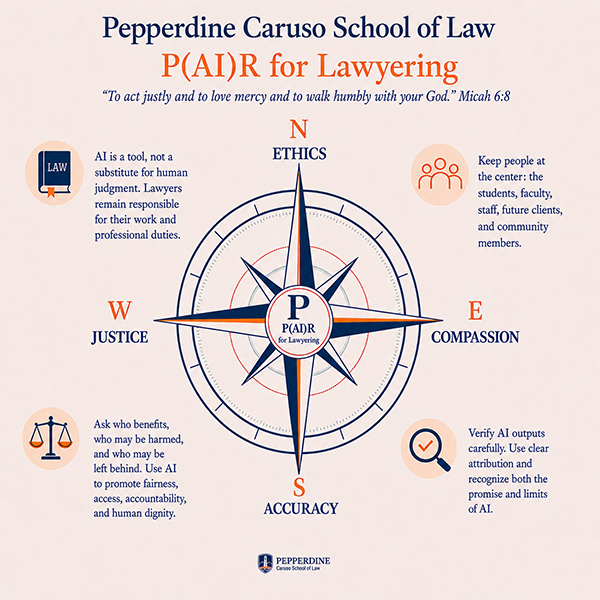
North and South Axis: Disciplined AI Use
North and South create the vertical axis of disciplined AI use. Ethics orients the work, while accuracy ensures that AI use remains verified and transparent. Specifically,
- Ethics orients the law school’s AI work as its “north star.” The call to “walk humbly” reminds us that AI is a tool, not a substitute for human judgment. Lawyers and staff remain responsible for their choices, their work, and their professional duties.
- Accuracy keeps AI use grounded in careful verification. The call to “walk humbly” also requires clear attribution to the sources underlying academic and legal work product and honest recognition of both the promise and the limits of AI.
East and West Axis: Human Impact
East and West create the horizontal axis of human impact. Compassion and justice work together as a continuum that reflects the call to act justly and love mercy. Specifically,
- Justice requires Caruso School of Law community members to ask who benefits, who may be harmed, and who may be left behind. The call to “act justly” requires them to use AI in ways that promote access, fairness, accountability, and human dignity and aligns with our Pepperdine mission to empower servant leaders.
- Compassion keeps humans at the center of AI-related decisions. The call to “love mercy” reminds us that, at the center of legal education and practice, are divinely created humans: students, faculty members, staff members, clients, and community members.
Practical AI Skills Credential
As artificial intelligence reshapes the legal profession, employers are seeking graduates who can use emerging technologies with confidence, competence, and sound professional judgment. Pepperdine Caruso Law's Practical AI Skills Credential equips students with the knowledge and hands-on experience to responsibly integrate AI into legal practice.
Available to all law students as a voluntary, non-credit credential, the program complements the traditional legal curriculum by developing practical AI fluency grounded in ethics, accuracy, and professional responsibility. Through structured training, students learn not only how to use today's leading AI tools, but also when to rely on them, how to verify their outputs, and how to recognize the limits of AI in legal work.
Responsible AI & Legal Ethics
Students complete two approved ethics experiences, including one live workshop or discussion, covering topics such as confidentiality, bias, accuracy, professional responsibility, and the ethical limits of AI. The emphasis is clear: AI can support legal work, but lawyers remain responsible for their decisions, analysis, and professional judgment.
Legal AI Tools
Students receive hands-on training in AI-powered legal research platforms, including Westlaw, Lexis, and an approved legal AI tool such as Harvey for Law Students. They learn how to use AI to enhance legal research and workflows while verifying all AI-generated results against primary legal authority.
General AI Skills
Students complete University training for Gemini and gain experience with at least one additional AI platform, such as ChatGPT or Claude. They learn practical ways to use AI for studying, organizing information, drafting, brainstorming, and problem-solving, while understanding AI's limitations and the importance of independent legal analysis.
AI Capstone Project
Students complete a five-minute recorded presentation demonstrating a practical AI skill relevant to legal education or law practice. Projects may showcase legal research strategies, ethical AI use, study tools, or other real-world applications that prepare students to use AI responsibly in their future careers.
Information about the student credential is available in the Student Guide

Workshops
P(AI)R for Lawyering will offer workshops that help students, faculty, and staff develop practical and responsible AI skills. The workshops will reflect the compass approach by reinforcing ethics and accuracy in AI use while considering justice, compassion, and human impact. Because AI tools and professional expectations will continue to change, the program will update workshop topics as new needs emerge.
Upcoming workshops for students, faculty, and staff will be listed here.
AI Guidance & Resources
Explore tools, policies, training opportunities, and best practices designed to support the responsible use of artificial intelligence in legal education and practice. This resource hub will continue to grow as new guidance, workshops, and learning materials become available.